1-844-934-2360 | rousseauslanding@outlook.com


Four Generations on Sandbar Lake

How one family’s 70-year tradition at Flayer’s Lodge became the story of Rousseau’s Landing.
Jim Fisher is 80 years old.
He’s been coming to Sandbar Lake since he was a boy of eight — almost 70 years now.
When we talked to him this past March from his winter place in Arizona, the first thing he told us was this:
“When you get to be 80 years old, you say every day is a blessing.”
— Jim Fisher, four-generation guest

A Tradition That Started Before the Highway
Jim remembers a time before Rousseau’s Landing existed — before the resort, before the cabins, before Highway 599 was even paved.
Back then, you needed a permit from the paper company just to get through the gate and onto Sandbar Lake.
The man who built the original resort was a Finnish-Canadian immigrant named Hilding Flayer. Jim watched him do it, piece by piece, with his own hands.
That was roughly 60 years ago, when the place was known as Flayer’s Lodge. Hilding and his wife Marion ran it with their daughter Judy, who still lives in Ignace today.
The camp started with a few cabins and some campsites and kept growing over the years — indoor bathrooms replaced outdoor ones, the fish cleaning house went up, and boats got cached across many surrounding lakes.
“He came from Finland and he built that resort with his own hands. I’m going to guess about 60 years ago. John Rousseau still has the records going all the way back.”
— Jim Fisher
Jim has his own records too — a thick folder back in Minnesota filled with receipts from the 1960s, old brochures, survival maps, and handwritten lake charts noting what species lived where. It’s almost an autobiography of the resort, told through one family’s fishing trips.
Four Generations, One Camp
That blessing, for Jim, has always included a week on the water in Northwestern Ontario.
What started as a boy following his father into the bush country around Ignace has become something much larger than one family’s fishing trips.

The tradition began simply enough.
Jim’s father brought him north to fish when he was about ten years old. Jim did the same with his own son. And now, Jim’s son brings his boy — 14 years old now — every year.
“My dad started bringing me up there when I was about 10.
I started bringing my son when he was about 8 or 10 years old. And now he’s been bringing his son up for the last at least five years.
So we’ve got four generations going up there.”
— Jim Fisher

But the chain doesn’t stop with blood.
Jim’s best friend and his family have adopted the tradition too.
Friends have become family on these trips.
And that’s when Jim said something that stopped us:
“They spend more quality time in that one week at Rousseau’s Landing than they do trying to catch up with each other throughout the whole summer and winter.”
— Jim Fisher

Think about that for a moment.
One week.
More real connection than the rest of the year combined.
No internet to check.
No news cycle to keep up with.
Just the people you came with, the lake in front of you, and the day’s plan.
“I’m carrying it on from my father. My son is carrying it on to his son. The sons are carrying it on to their grandsons.”
— Jim Fisher

The Rhythm of a Week in June
Jim’s group — nine people, two cabins, three boats trailered up from the Minneapolis suburbs — arrives every June like clockwork. They leave at seven in the morning, arrive by five, and the boys are on the water by seven that evening.
From there, the days find their own pace.
“We’d go out for the evening run after dinner and fish up until 10 o’clock. And that’s still light. You could keep fishing. Sometimes the boys will stay out after dark. That sun comes up pretty early — 5, 6 a.m. So I try to get to bed at 10 and get up at 6, have a good breakfast, and decide what lake we’re going to based on the weather and the wind.”
— Jim Fisher
That’s the land of the midnight sun in June.
Long days.
Calm evenings.
The kind of light where you lose track of time because the lake won’t let you stop casting.
Jim’s group holds a trophy contest each week for the biggest walleye, but they’re all about catch and release.
“We put back all the big walleyes. We just keep the slop walleyes at 18 inches. The big ones are all back swimming in the lake to get bigger and make more big fish babies.”
— Jim Fisher
70 Years of Reading the Water
When you’ve been fishing the same lakes for seven decades, you learn things that no guidebook can teach you.
Jim’s approach is simple, and he’ll tell you exactly what works.


“The best lure out there is a jig and a minnow, or a jig and a half a nightcrawler, or a jig and a leech. Just bouncing it off the bottom. I always say it’s presentation, technique, execution. What you’re presenting them, keeping it bouncing, setting that hook, keeping a tight line, and bringing them right in.”
— Jim Fisher
He knows the seasonal patterns by heart.
➢ June is prime time — walleye are shallow and schooled up, and you can catch them one after another.
➢ Summer pushes them deep onto the reefs, down 20 feet or more.
➢ By September and October they start coming back up. The numbers aren’t as big in the fall, but the fish are.

Jim identifies specific lakes around Ignace for lake trout — deep, cold bodies of water like Victoria Lake and Cecil Lake. He points out that the area doesn’t hold muskie (you’d need to head toward Dryden for that), and he’ll tell you the smallmouth bass are “like footballs” — big fish that most people catch by accident because they’re not even targeting them.
And then there are the northern pike stories.
“We were reeling up a decent-sized walleye right to the boat and a big northern just grabs that walleye and takes off. Zing! The line’s flying and the big 20-pound northern is running with the walleye. We even netted both fish. The northern wouldn’t let go.”
— Jim Fisher
He’s seen northerns over 40 inches.
He watched one get cleaned at the fish house with a muskrat pulled right out of its stomach. He’s seen big pike washed up on shore with walleye lodged in their throats. These are the kind of stories that only come from spending a lifetime on the same water.
Turning the Clock Back
Jim comes back to the same idea more than once during our conversation: the trip is a way to step outside of time.

Away from screens, away from noise, away from the pace that grinds everyone down the other 51 weeks of the year.
“In today’s fast-moving world, it’s like turning the clock back a generation or two. I tell my kids the story of my father taking me up there as a kid, and it was really rough, and they shake their head. It’s gotten better over the years, but it’s still a challenging, fun, active trip.”
— Jim Fisher
Over the years, Jim has donated mounted fish to several cabins at the resort — lake trout, walleye, northern pike — each with his name on it and a story behind it from his kids’ early years.
Those mounts are still there.
They’re part of the place now, the same way Jim’s family is.
A Story That Needs to Be Told
Near the end of our call, Jim said something that caught us off guard. He wasn’t talking about fishing or the weather or the roads.
He was talking about why any of this matters.
“It’s something that needs to be told. It’s testimony for the future generations. There’s still a lot of families that continue the traditions, both up there in Canada and down in the States, that love to fish and will make that drive and commitment to be up there for a week of solitude with their families.”
— Jim Fisher

Jim Fisher has been coming to this lake for nearly 70 years. Four generations of his family have fished these waters. He’s watched the resort grow from a gated gravel road with a few cabins to what it is today. And he plans to keep coming back, twice a year, for as long as his health allows.
His story isn’t unique at Rousseau’s Landing — it’s the pattern.
Families come back. Year after year.
Generation after generation.
The lake stays the same.
The tradition carries on.
That kind of loyalty doesn’t happen because of marketing. It happens because a place earns it, year after year, by being exactly what it promises to be.


How the Camp Has Grown Over the Years
| Then | Now |
|---|---|
| A handful of rustic cabins | 14 housekeeping cabins sized for couples through large groups |
| Basic lake access | Boat caches on a dozen surrounding lakes |
| Simple camp structure | One of the largest fish houses in the area with walk-in freezer |
| Fishing-focused | Full fishing, bear hunting, and moose hunting programs |
| Word-of-mouth only | 90–95% repeat customer rate built over decades |

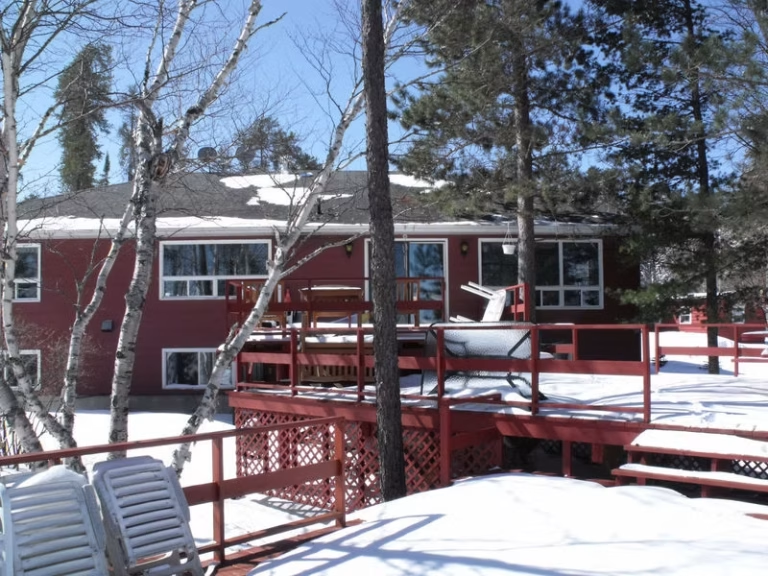
The lodge still has its red siding.
The architecture is still simple.
The layout is still built around outdoor living, not resort amenities.
That’s not an oversight — it’s the whole point.
Why Does the Town of Ignace Matter to This Story?
You can’t separate Rousseau’s Landing from the community around it. Ignace sits on the Trans-Canada Highway, five minutes from camp. Check our Ignace Weather and Business page to find out where guests pick up live bait, grab groceries, fill prescriptions, or stop at the LCBO.
Find medical services and weekend on-call support. R & C Repairs has bailed out more than a few guests with unexpected vehicle trouble at the end of a long week.
These aren’t just local businesses. They’re part of the experience. Guests tell us they feel welcome the moment they turn off Highway 17 and head north on 599. That warmth starts in Ignace.
How Did Hunting Become Part of the Story?
The fishing came first. Sandbar Lake and its surrounding waters have always been the backbone of this camp — Walleye, Northern Pike, Lake Trout, Perch, and Smallmouth Bass across a network of boat cache lakes that gives anglers a different option every day of the week.
But the same location that makes fishing so good also made hunting inevitable. The boreal forest surrounding camp stretches in every direction — spruce, jack pine, birch, and poplar, laced with logging roads and fresh cutovers. The wildlife followed the habitat: moose, black bear, ruffed grouse, spruce grouse, bald eagles, and loons.
Today, fall hunting is as much a part of Rousseau’s Landing as summer fishing. Hunters travel from across Ontario and the United States to use this camp as their basecamp for bear and moose season. The fact that the property borders multiple Wildlife Management Units from a single location gives hunting parties something most camps in the region can’t offer.
What Keeps People Coming Back After All These Years?
It’s not one thing. It’s everything together.
- The independence — guests control their own schedule, meals, and pace
- The quiet — no other resorts on the lake, controlled access inside the Provincial Park
- The consistency — the fishing is reliable, the cabins are comfortable, the setting doesn’t change
- The community — families build traditions here, fishing groups maintain annual dates, hunters return season after season
- The simplicity — this is not a luxury resort, and that’s exactly why people love it
The stories around the fire pit get longer every year. That’s exactly how it should be.
If you want to understand what Rousseau’s Landing is really about, the best place to start is the history and the people who’ve shaped it.
See current fishing packages and cabin options →
Questions? Start with the FAQ →